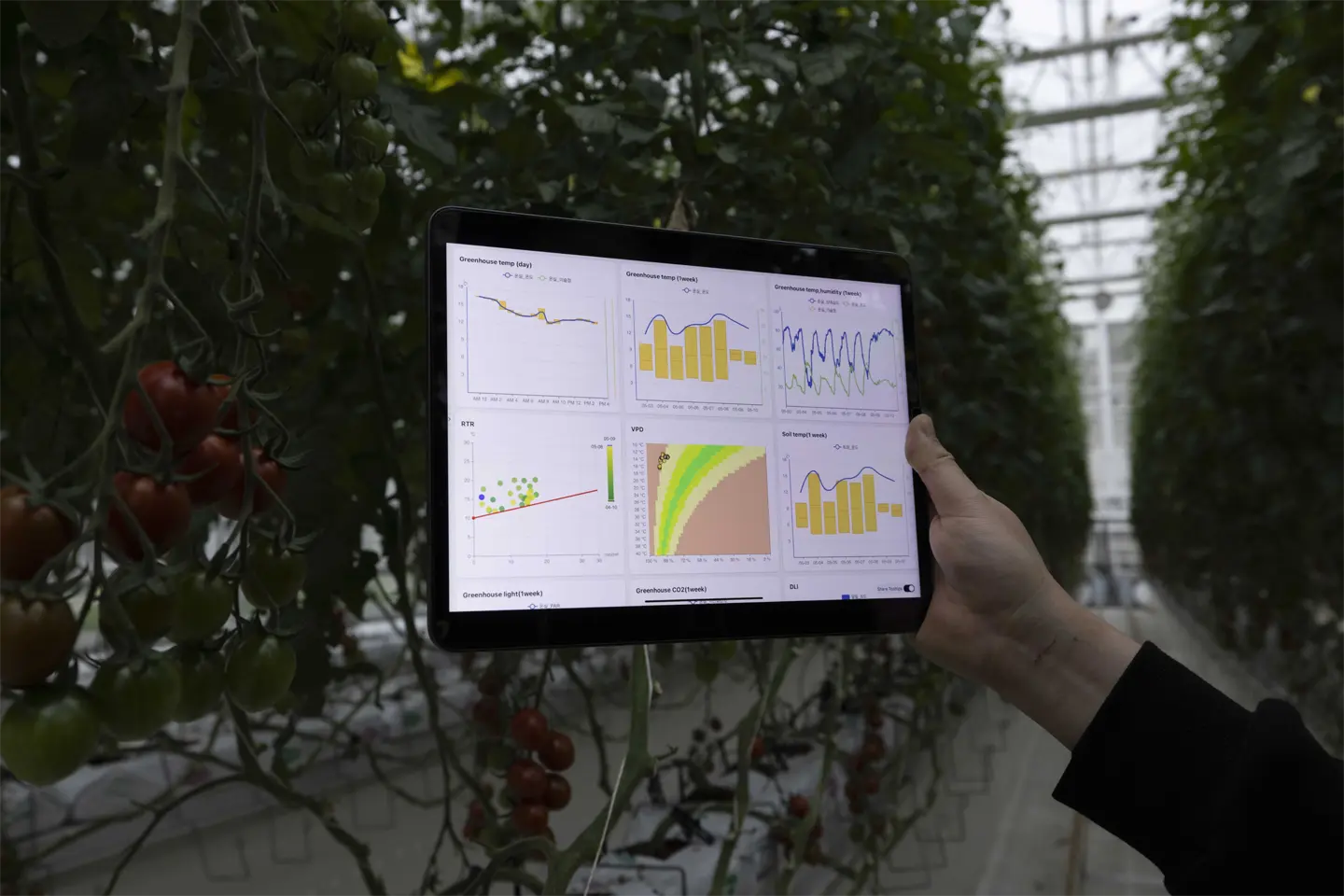
Technology led by plant response

Technology led by plant response

Croft's system reads how plants respond, interprets those signals, and automatically adjusts the environment in real time, without waiting to be told.

System overview

One system connecting everything

Croft operates as a closed-loop greenhouse automation system where sensing, learning, and action are constantly connected.

Nothing operates in isolation. Every component feeds the same decision loop.
Environmental sensors
Establish the conditions in the greenhouse as a baseline.
Crop-responsive AI (GrowPilot)
Interpret how crops are responding to those conditions.
Scanning robots (GrowBots)
Observe crops directly and carry out targeted actions.
Greenhouse control systems
Adjust the environment based on what the crops need.
Environmental sensors
Establish the conditions in the greenhouse as a baseline.
Crop-responsive AI (GrowPilot)
Interpret how crops are responding to those conditions.
Scanning robots (GrowBots)
Observe crops directly and carry out targeted actions.
Greenhouse control systems
Adjust the environment based on what the crops need.
How it works

Letting plants lead

Croft is built on a simple idea: the most reliable way to grow better crops is to follow the plant itself.

Instead of relying on indirect signals or delayed human intervention, Croft observes crop responses directly and acts on them.
See our solutions
Core technology

Four technologies working as one system.

Croft's crop response intelligence layer is built on four capabilities: accurate sensors, growth modeling AI, automated robotics, and smart control systems. Each is strong on its own, but together they provide an unmatched level of insight into how your plants are growing.
01.
Precision sensing
Reading the environment accurately
Plant response tells you what's happening. Environmental data tells you why. Both are necessary.  

Temperature, humidity, light, CO₂ — these readings give our AI the context to understand cause and effect across growth cycles. But no decision is made on sensor data alone. It is one input among several, weighted against what the plants are showing.

In Croft's turnkey systems, we use Priva sensors and statistically modeled infrastructure across every deployment.
Precision sensing
environmental sensors ensure
01.
Highly accurate signals
Better signals provide the best environment to nurture your crops.
02.
Long-term reliability
Modeled infrastructure built for 24/7 operation.
03.
Stable automation
Consistent inputs across single sites and multi-site operations.
Difference
The quality of the input determines the quality of the decision. Better signals mean more precise adjustments and more consistent crops.
02.
Growth modeling
Autonomous control built on crop response
Croft's AI, called GrowPilot, builds a living model of how your specific crop responds to its environment.

GrowPilot learns how crops respond to their environment — not just what conditions are, but what they produce. It adjusts climate and irrigation automatically based on real plant behavior, not fixed rules.

Electricity, water, and nutrients are applied only where they drive measurable growth, allowing us to get the highest yields for the least amount of resources.
Growth modeling
GROWPILOT COMBINES
01.
Environmental data
Light, temperature, humidity, CO₂
02.
Plant modeling
With GrowBot scans, the AI assembles a full model
03.
Historical performance
Growth from previous cycles
Difference
"Growth modeling" means predicting how changes in light, temperature, humidity, or CO₂ will affect real plant development and not just responding to sensor readings or preset ranges.
03.
Crop-responsive AI
Seeing what sensors and humans can’t
Environmental sensors tell you what the air is doing. GrowBots tell you what the plants are doing. These are not the same thing.  

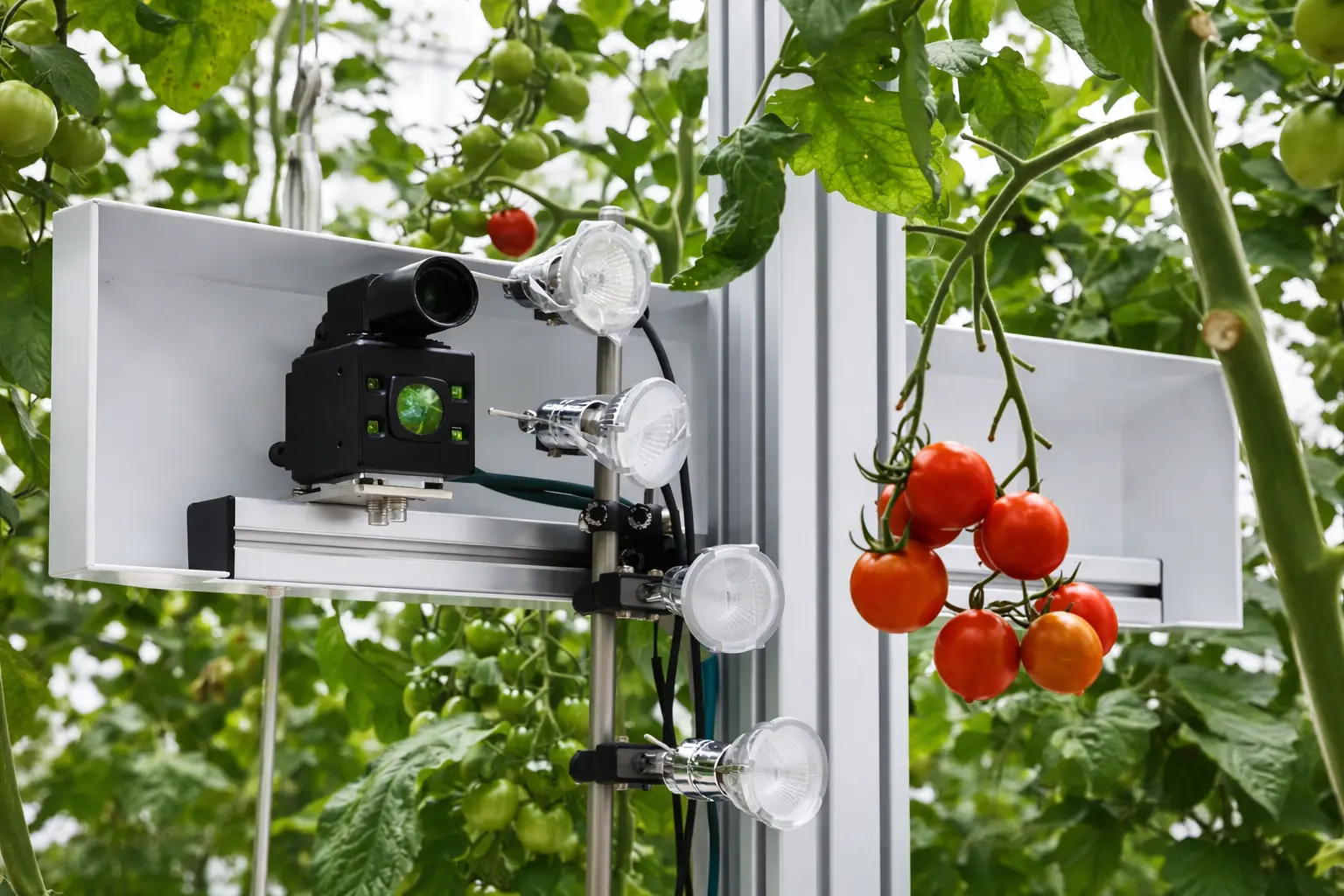
GrowBots move autonomously through the greenhouse, scanning crops and tracking plant metrics (shape, volume, growth rate, and early stress indicators) at a level of detail that fixed sensors can't reach and that people can't sustain across a full operation.

This gives Croft plant-level visibility so accurate it catches problems earlier than traditional crop registration methods can. Stress, disease, and growth deviation become visible before they become a loss.
Crop-responsive AI
Growbot's CAPABILITIES
01.
Inspection
Plant-by-plant scanning at scale.
02.
Plant removal
Targeted action where issues occur.
03.
Harvesting
Triggered when conditions are met.
Difference
GrowBots offer observation and action bundled together in one cost-effective and intelligent solution.
04.
Environmental control
Closing the loop between signal and action
Sensing tells the system what is happening. Control infrastructure is how the system responds.

Once GrowPilot determines what the crop requires, it acts directly on the physical environment — adjusting climate, irrigation, and inputs without waiting for manual intervention. The control layer is what turns intelligence into reliable outcomes.
Environmental control
The systems cover
01.
Climate control
Heaters, ventilation, and CO₂ levels are adjusted in real time as conditions shift.
02.
Irrigation and nutrition
Are applied at the rate and timing needed for the crop's current growth stage.
03.
Lighting and shading
Are modulated to match the light response patterns our AI has observed in your specific crop.
Difference
Every action the system takes feeds back into the model. The next cycle starts from a better position than the last.
Results

This continuous decision loop delivers measurable outcomes that no single technology could provide.

AI-enabled
Resources applied only where they drive growth — highest yields with less input.
Driven by ROBOTICs
Issues detected and addressed at the plant, earlier and more precisely than any human or sensor alone.
Intelligent Infrastructure
Signal integrity that keeps the loop stable and reliable, no matter how large the operation is.
Ready to move your operation forward?
Next steps
Ready to move your operation forward?
Every facility is different — different crops, different infrastructure, different goals. Croft's system is built to adapt. If you want to understand what autonomous growing looks like for your specific operation, we can walk you through it.

Frequently Asked Questions

Got other questions that you need answered? Contact our team, and we will help you figure them out.

How long does it take for the system to learn a new crop?

+

Our AI, GrowPilot, begins building a crop model from the first cycle in a facility. Early decisions draw on the foundational data Croft has developed across deployments, combined with the environmental and plant-level data collected from day one in your specific environment.

By the end of the first and second cycles, the model has accumulated enough facility-specific data to produce meaningful adjustments. By the third and fourth cycles, growers typically see a noticeable shift in the consistency and yields with fewer manual interventions and more predictable outcomes.

There is no fixed learning period; the model continues to improve as long as the system is operating. Longer deployments produce better results, which is one reason Croft is designed for ongoing operation rather than short-term analysis engagements.

→  Talk to us about your first deployment

What crops and facility types does Croft support?

+

Croft's system is designed for commercial controlled environment agriculture (CEA) — facilities where environmental conditions can be monitored and adjusted systematically. This includes glass and poly greenhouses, vertical farms, and hybrid indoor growing environments.

In terms of crops: the system has been developed with a focus on high-value, high-sensitivity crops where yield consistency and resource efficiency matter most. Leafy greens, fruiting crops such as tomatoes and peppers, berries, herbs, and specialty produce are the primary categories. We can even support beautiful flower nurseries, too.

Because GrowPilot builds crop-specific models rather than applying a generic baseline, the system adapts to the particular response patterns of each crop type. New crop profiles develop over the first cycles in a facility and continue to improve with every subsequent cycle.

→  Explore our solutions

Does Croft replace the head grower?

+

No. Croft handles the majority of crop registration: the continuous monitoring, interpretation, and adjustment work that currently falls on the growing team. This work happens between decisions, around the clock, across the whole facility, and typically demands a higher salary.

What it gives back is time and precision. The head grower's expertise goes toward strategic decisions: crop selection, cycle planning, facility development, and quality standards. The system handles checking that everything is going according to that plan and reacts if something deviates from it.

For many operations, the more accurate framing is that Croft makes the head grower's knowledge scalable. The judgment that one expert grower applies intuitively in one section of a facility can now inform the whole operation, consistently, across every cycle — without requiring that person to be everywhere at once.  

This support typically means we can reduce the demand for crop registration work by 75%, and it’s one of the factors that helps Croft make growers turn a profit faster and more consistently.

→  Talk with a growing expert about your operation

How is Croft different from a rule-based automation system?

+

Rule-based automation executes fixed responses to fixed conditions: if CO₂ drops below X, open the valve. If the temperature exceeds Y, activate cooling. The rules are set in advance and applied uniformly. They work well in stable, predictable environments.

The problem is that greenhouses are not fully predictable. Crops respond differently at different growth stages. The same input produces different outcomes depending on what the plant has already experienced. A rule written for week three of a tomato cycle may be exactly wrong for week six.

Croft doesn't execute rules. It builds a model of how your specific crop responds and adjusts based on that model. When conditions change in a way that hasn't been predefined, the system adapts because it understands the relationship between inputs and outcomes, not just the threshold that triggers an action.

What is crop-response intelligence?

+

Crop-response intelligence is Croft's term for a system that learns from how plants respond to their environment and acts on that learning directly.

Most growing systems are built around control: set a target temperature, maintain a CO₂ range, trigger irrigation at a scheduled time. The environment is managed according to a plan.  

Crop-response intelligence works the other way. The plant's true north and how it’s actually growing are the main signal that guides everything. Environmental controls adjust to match what the crop is telling us, not what the plan assumed it would need.

This distinction matters practically. Two crops in the same facility, at the same growth stage, under the same nominal conditions, can respond differently based on seed variation, prior stress, or subtle infrastructure differences. A plan-based system treats them identically. A system with crop-response intelligence detects the microscopic differences in each plant and adjusts the environment accordingly.
→  Read more about crop-response intelligence

Resources

Company news and updates

Here's the latest news and information about Croft.