
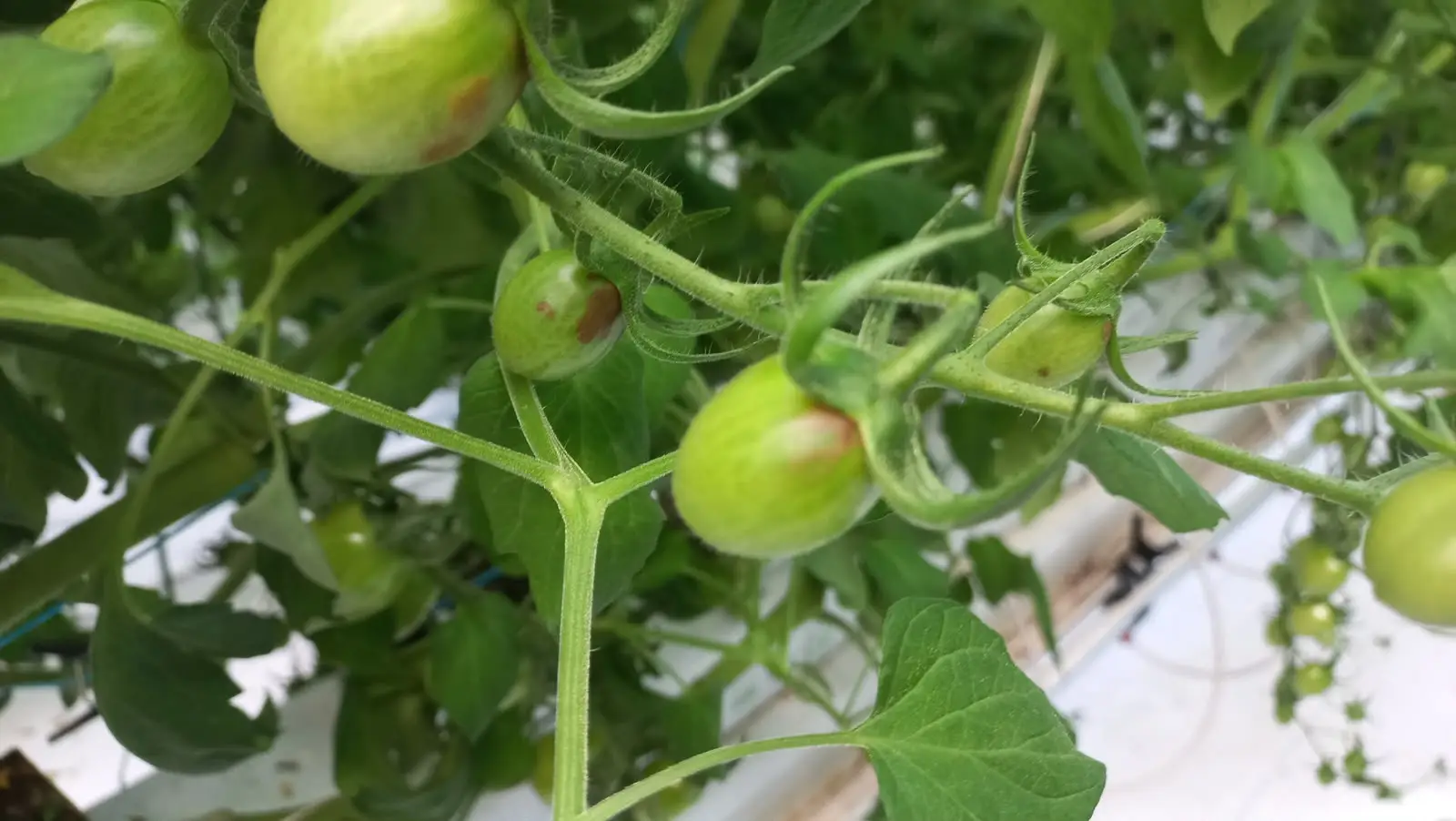
I was floored when our greenhouse team told me the news.
“I think we might have a virus…”
Our grow team works by going over the plants one by one, so they know them best. Now they were saying an area looked wrong. I personally scout the greenhouse every week, and our head grower walks it every day. But this time, the laborers spotted it first.
I rushed to the area mentioned, and there it was… a mosaic pattern on the leaves.
I described the symptoms to the breeder, our seed company, and they asked for samples. They had been receiving reports of the virus from other greenhouses. The results came back positive for Tomato mosaic virus (ToMV) and negative for tomato brown rugose fruit virus (ToBRFV) and the other viruses tested. ToBRFV is the second virus now moving through Korean tomato greenhouses. Ours tested clear of it.
ToMV is not new to Korea, and tomato cultivars bred to resist it exist. It still spreads easily. The virus moves in plant sap, so a hand or a blade that touches an infected plant and then a healthy one carries it. We have 25 gutters, the long lines the plants grow in. The infection started in gutter 24 and ran fast along that line, because one knife was cutting plant after plant. Once we contained the outbreak, the spread slowed.
With a virus that has no cure, I had two options: keep the crop and manage it or remove everything and start over. The plant's health is what decides which options are even viable. That choice exists for ToMV. For ToBRFV, it does not, because under the emergency measures announced by the Rural Development Administration, infected greenhouses must destroy their plants, harvested fruit, and the growing media.
Our plants were young and healthy. A fully infected plant follows a recognizable course. The growing point at the top wilts, turns yellow, curls and wrinkles, and dies, and then the rest of the plant follows. Ours turned yellowish and went no further. Some plants looked abnormal. None were fully affected.
We had been photographing the growing points almost daily in our crop-monitoring app, and the photos showed new growing points still appearing. The plants were alive. I put it down to their age and health, the way the same virus can hit one person hard and barely trouble another.
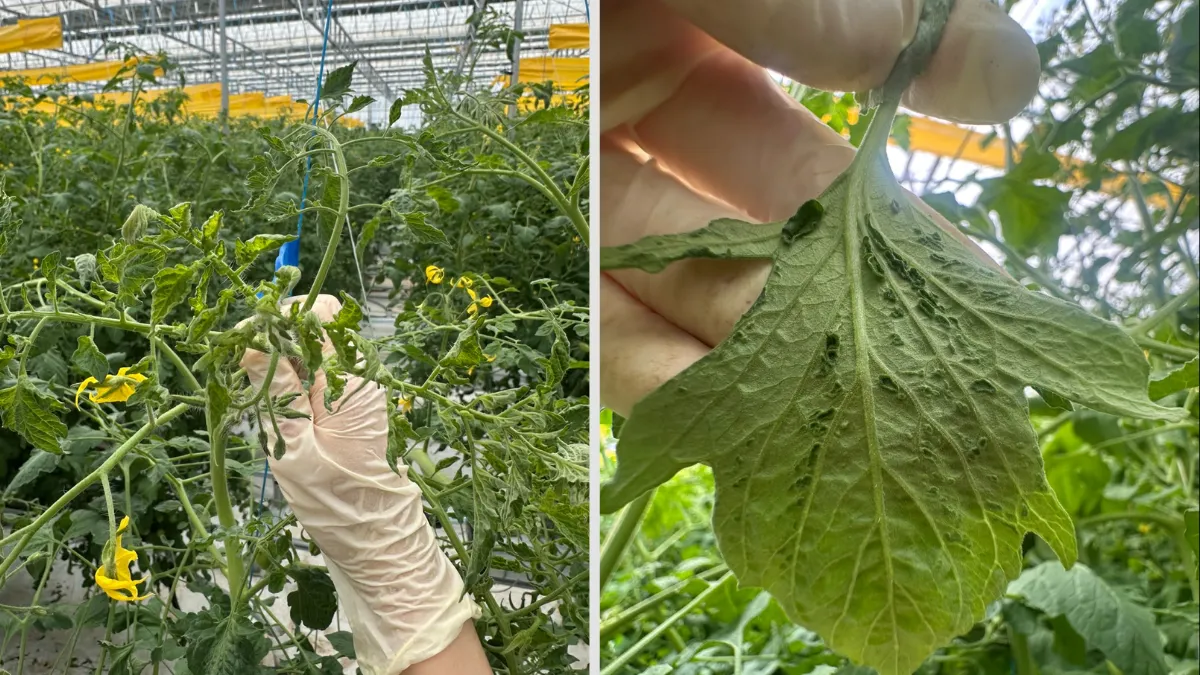
I chose what I call a "soft transition." The infected plants still carry a lot of fruit, so they stay, and we harvest until about the end of December, when I will stop them growing and we will keep picking what is already on them. Between those plants we have interplanted seedlings of a ToMV-resistant cultivar. They need about eight weeks to grow, and the old plants have about eight weeks of harvest left, so picking does not stop. The aim is to have the highest yield from both in January.
The extra cost was the resistant seedlings and the labor to transplant them. It was small, but it was still an extra cost we wouldn’t have sustained without the virus. Clearing the greenhouse would have cost us far more. We would have had to dispose of the plants and sterilize everything, and probably wait until December or January to plant again. Issues like this can really set growers back, and often they need to take out loans to cover the shortfall if they don’t have savings for such emergencies. For growers that are already heavily leveraged, it could bankrupt them.
As of November 13, the Rural Development Administration had counted ToBRFV at 117 tomato farms, up from 39 four days earlier, though wider testing likely explains some of that jump.
They were in six regions, and more than half were in North Jeolla, where the first case was confirmed on October 20. On November 11, the administration announced emergency containment, and growers can replant only after tests show the virus is gone.
The administration’s count for South Chungcheong was 15 farms, but the province itself had counted more by November 7: 65 confirmed farms and 136 suspected. And according to the center where I send my tomatoes to be sold, the APC, citing agriculture ministry research, the number in the Buyeo area of that province could be as high as about 300 greenhouses. That figure reached growers in a text message and is not an official statistic.
ToBRFV goes after the fruit. Infected tomatoes develop brown spots and wrinkled patches. The resistance bred into tomatoes against ToMV does not protect against it. No cultivars resistant to ToBRFV are available in Korea. I expect many growers with the virus to stop production, January yields to fall, and prices to rise. Resistant seed will probably have to be imported, and some growers may be unable to grow tomatoes for years. I feel very sorry for the other growers, including us.
The Korea Herald reports yield losses of 30 to 70 percent in crops infected with ToBRFV. Here is what a loss in that range does to a farm's margin. These numbers rest on stated assumptions and come from no real farm's books.
Say a greenhouse keeps 15 cents of every crop dollar after costs, and the other 85 cents goes to costs that do not fall when the harvest does: energy, tending labor, seedlings and loan payments. For every $100 of fruit the farm planned to sell, a 30 percent loss leaves $70 of revenue against $85 of costs, a loss of $15. A 70 percent loss leaves $30 against $85, a loss of $55. Under the same assumptions, a grower who has to destroy a crop loses the full $85, plus the cost of clearing.
The government has said it will cover control and replanting costs for ToBRFV farms and is preparing compensation for destroyed produce, which should soften the blow. Buyeo County alone estimates its tomato losses from the outbreak at about 11.7 billion won.
Since the day we found the ToMV virus, no outsiders enter the greenhouse. Extra laborers change all their clothes and leave their glasses, smartphones and watches outside, and the team disinfects everything before they come in. We hire only from nearby, away from infected farms. We disinfect a knife after every use and swap it for another.
Hygiene protocols in Korea are easily neglected. Greenhouses stay open and people come and go, because the country had never faced a virus this serious. Keep your protocols. Visit other greenhouses rarely, because people carry these viruses between farms. Once a virus has spread, nothing can be done about it. Visitors are the usual route for both viruses, and I cannot say how long it was in our greenhouse before the laborers noticed.
Our main GrowBot™ normally scans the crop on a regular schedule and compares the same plants from one scan to the next. So why didn’t it catch this? It wasn’t there. For the past few weeks, we have been upgrading and testing the new two-armed version in our lab, so it was not scanning the cherry tomato commercial facility we use for R&D. We have no scans of this crop from that time.
The changes we found by walking the rows were a mosaic pattern on the leaves and yellowing at the growing points, and those are visible changes. On a normal schedule, a scan might have shown us those changes sooner than the laborers did. We can’t know for sure.
What we did have was manual. Our crop-monitoring app contains regular crop registration data, daily scouting notes, logged issues and the growing-point photos. People enter all of it. The app records what our team observes, so it could not raise an alert ahead of us.
Whether scans can catch this virus before any leaf changes is a different question, and the published research does not settle it. A 2023 study picked up a virus in tobacco leaves four days after it reached them, using hyperspectral imaging, and a 2008 study found chlorophyll fluorescence changes in infected leaves of a model plant that showed no symptoms. Both were lab studies, not working tomato crops. When the upgraded GrowBot is scanning again, the infected plants and the new seedlings will give us scans to compare against our photo record.
We keep the photos and every logged issue so we can train our artificial intelligence (AI) on them later. The aim is to teach it to see what those workers see. Responding to what the plant is showing you is the principle our work rests on. The laborers did it first.
This is a decision in progress, made for one greenhouse. Growers whose plants were not healthy enough had no option but to clear everything at full cost. We have one lab result, from the seed company's test, and no scans from these weeks, so the claim about GrowBot stays unproven until scanning resumes. We are not claiming the approach works for any other greenhouse. We will report back in January on how the old plants and the new seedlings did.
I belong to two grower group chats. In one, growers who also had ToMV compared what they were seeing and worked out the interplanting approach together. In the other, growers dealing with milder viruses got my ToMV experience and a request not to visit our greenhouse.
We shared information in real time. We decided together what to do next. As growing can be a very lonely job, I want our app and our AI to have a grower's back the same way.
Subscribe to Croft Quarterly to get a short overview of what we did over the quarter and what we are working on next in the coming months.


