
A greenhouse doesn't fail all at once. Failure is the result of a thousand tiny mistakes coming to a head: a setpoint held a half-degree too long, a nutrient dose sized for last week's plant instead of today's, a shift change that loses the read a veteran grower had on the crop. None of these issues show up on a sensor log. They show up weeks later, in uneven fruit sizes across a block that got identical treatment on paper.
Every commercial grower already knows this pattern by feel. Getting a consistent yield depends on judgment that's slow to develop and doesn't transfer when the person holding it leaves the room. The industry keeps calling that a labor shortage. It's a knowledge problem instead.
For the past decade, the industry's answer has been more information: better sensors, smarter alerts, dashboards that plot climate trends across every zone in real time, and phone notifications the moment a reading drifts. All of it added visibility, but the decision stayed with the grower. Even fully instrumented operations still run on broad, coarse-grained control strategies. The data is there, but the number of ways temperature, humidity, CO2, and irrigation interact hour to hour is too large for a fixed rule set, or a person, to manage with precision. The tools got better, but the bottleneck remained.
Croft starts from a different premise: the plant is the primary source of truth, and the system's job is to act on what it reads from the signals each plant is independently giving. That's crop response intelligence, and it's the difference between a system that tells a grower something and a system that removes the decision from their day entirely. That distinction plays out differently depending on what's actually installed.
Crop registration exists because growers have always needed a way to check whether a crop is developing as expected. The limitation was never the idea; it was the scale: a person can only walk so many rows, so often. We built GrowBot to remove that ceiling — not to replace the judgment behind crop registration, but to give it reach across the whole crop instead of a sample of it.
A typical facility only registers about 0.25% the total plant population, larger operations survey an even lower percentage. For most operations, that’s somewhere between 10 and 20 plants per session. To keep that small sample honest, growers deliberately register plants from the middle of the greenhouse and avoid the edges, where corners run hotter or colder than the rest of the space. That's a sound choice, but it means the data feeding every decision downstream is a small, carefully curated slice of the crop, not a clear image of the whole thing.
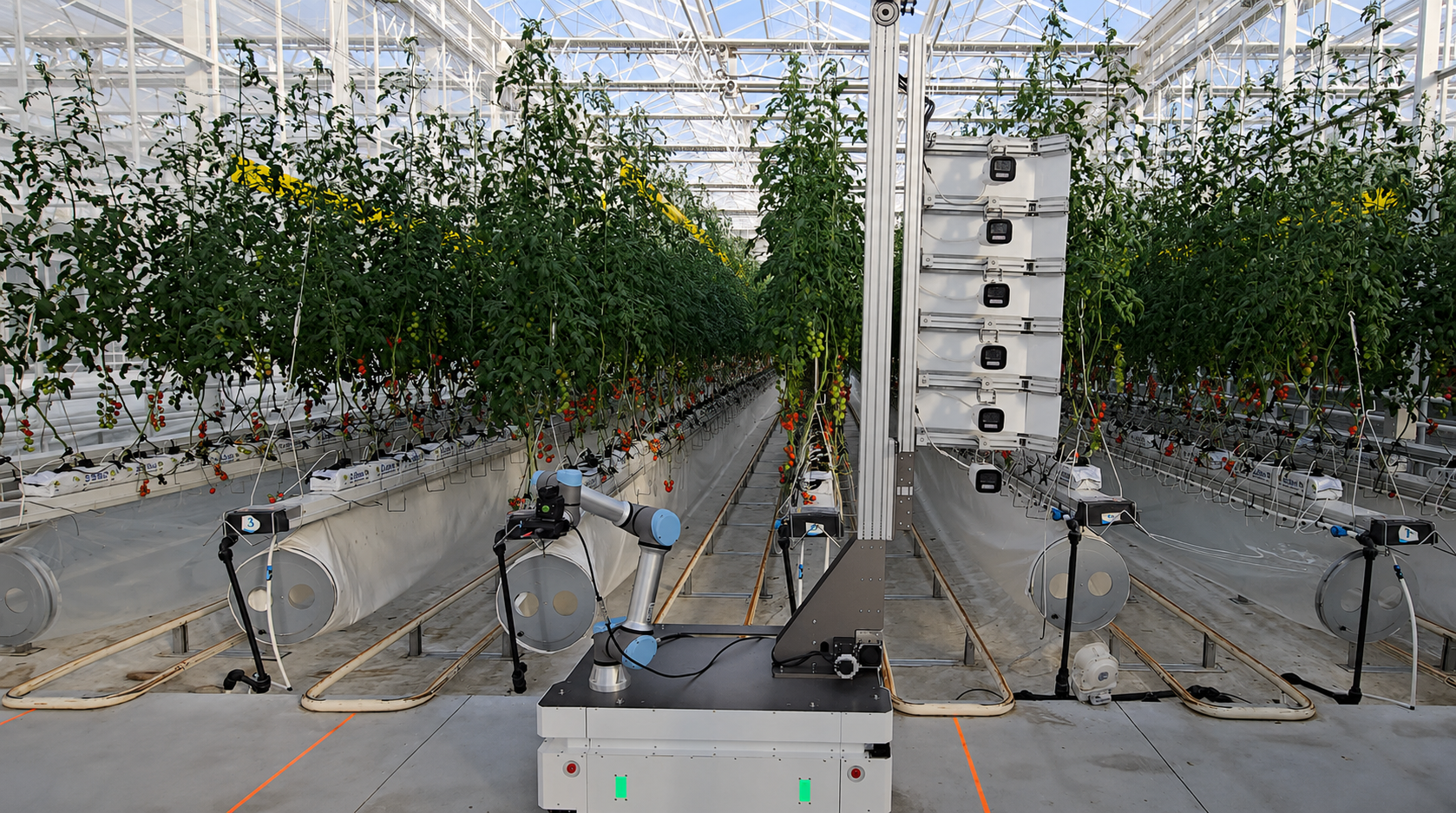
Customized to your facility and crop type, GrowBot reads the crop's phenotype continuously, the same physiological signal crop registration is built to capture, just at a completely different scale. Instead of a hand-picked sample of a handful of plants once a week, the full canopy gets completely covered at more frequent intervals, without depending on a skilled worker walking the rows. GrowBot doesn't just capture that signal; it acts on it by adjusting the crop's growing conditions in real time. GrowBot can also detect diseased plants and prune or remove them immediately before the problem spreads.
GrowBot's direct plant-level observation and automated interventions run on top of GrowPilot, the core AI model driving climate, irrigation, and facility-wide decisions in real time.
For facilities that aren't ready for a full custom GrowBot deployment (whether that's because of budget, facility layout, or timeline) GrowPilot operates as a complete, adaptive control system on its own: continuously adjusting temperature, humidity, CO2, and irrigation, and refining its read on a strain's needs using crop registration and cycle-outcome data.
The tradeoff is feedback speed. Because GrowPilot judges results at the cycle level rather than from a direct plant read, calibration lands toward the longer end of Croft's six-month training range. But facilities running GrowPilot alone still see real, measurable gains from out of the gate in efficiency, whether that’s in electricity, water, fertilizer or time spent looking at dashboards. It's a fully functional control system, and the powerful mind inside our GrowBots.
When a facility is ready to add GrowBot, the direct plant-level signal plugs into the environmental intelligence GrowPilot has already built, giving the system a more complete and more frequent read on the crop’s status, unlocking the next tier of autonomous control.
It takes 3 to 6 months to train our GrowPilot for your specific facility and crop. The system needs that time to capture a full seasonal range and events that don't follow a predictable schedule.
A single month of data can't contain the swing between peak summer conditions and shoulder season. The system must watch the plant's actual response across that full range before it can act reliably in all of it. Rare events matter even more: a heat spike, a sudden pest pressure event. These can't be simulated or scheduled. The system must wait for one to happen, watch how the plant responds, and confirm that response before it earns the right to act on a similar event alone next time.
Growers already work inside a three-to-five-month window to balance production against resource use, with or without an autonomous system, simply because of how large that decision space already is [1]. Croft's training period tracks close to that same natural cycle length. The system is learning inside a window the grower already lives inside, not adding one on top of it.
The mechanism behind that training period isn't trial and error. It's closer to controlled experimentation: running sets of plants across a matrix of environmental variable combinations and reading the comparative growth data across that matrix, rather than waiting to see if one live decision succeeds or fails. Where that comparison produces a clear, confident signal, the domain moves toward autonomous control faster. Where the plant's response is noisier, or takes longer to differentiate across conditions, that domain stays under closer human oversight for longer. Calibration speed isn't uniform across every decision a greenhouse makes, and it shouldn't be.
This depends on infrastructure being in place first. Sensing has to include physiological signal, not just environmental readings. Actuation has to execute a command, not just log one. And the data feeding the system has to run continuously; a gap in the record is a gap in what the system can learn from. Platforms elsewhere in this space have converged on the same three categories, sharing environmental trajectories, equipment-specific tuning, and seasonal control templates across fleets of deployments. Serious infrastructure in this category requires exactly this. Croft didn't invent these pillars of smart greenhouses; we just improved how they are managed.
Every grower who's been sold an "autonomous" system before has the same suspicion: the vendor is hiding how often they'll still need to step in. That suspicion is earned — they've seen this pitch before. Here's the direct answer.
During calibration, when a setting reads as too tight or too loose for what the plant needs, Croft flags the change and, where the facility is large enough, tests it on an isolated section of the grow space before rolling it out across the whole crop.
Manual override after the fact — a human catching and correcting a live decision Croft already made — is rare. What's more common is the reverse: a grower confirming a change Croft proposed before it runs. Growers also set how many alerts they want when the system adjusts its own baselines, so visibility into that process is a setting, not a fixed amount.
Over time, most growers stop overruling Croft's proposed changes. Not because they've stopped paying attention, but because by the time something's flagged, the system has usually already caught the shift in the plant's physiology before a walk-through would have.
That still leaves the honest question a skeptical grower should ask: if a human can weigh in at all, is this actually autonomous? The answer is that autonomy here is scoped. It expands domain by domain, as confidence in that specific decision is earned rather than granted all at once across the whole operation.
Croft isn't alone in drawing that line. Even in the most competitive corners of autonomous greenhouse research, teams that trust their own systems enough to enter them in head-to-head competition still impose their own limits on what those systems can decide alone, specifically to prevent errors. Scoped autonomy isn't a compromise. It's what every serious system in this category looks like when it’s operating in the messy, real world.
Across the more than thirty facilities running Croft today, the pattern holds regardless of which side of the system is deployed. Greenhouses running GrowBot see annual yield improve two to four times over, and each GrowBot deployed gives growers back somewhere between eighty and one hundred hours a month that used to go into manual monitoring and adjustment. GrowPilot-only facilities see real gains too, on a slower calibration curve, since the system is still working from cycle outcomes rather than a direct plant read.
It's a growing set of decisions an operation no longer must make manually, expanding as each domain earns the trust to run on its own.
Croft didn't arrive at any of this by avoiding the mistakes other autonomous systems have made. We went through them all as well. In an early competition built specifically to test autonomous control against a living crop, Croft's own team won the simulated round by a wide margin, then dropped several places in rank once the model needed to grow a real crop. A simulation can't account for all the variability of life.
That problem wasn't unique to our experience in the challenge. In the most recent running of that same competition, results were still headlined by teams whose strong simulation performance didn't transfer directly to the real greenhouse once the crop was in the ground. The gap between simulated performance and a living crop hasn't closed industry-wide. We are just helping to break new ground in what we are convinced is the future of farming with crop-responsive AI.
The training period, the infrastructure, the necessary overrides: each is a crucial part of the journey our AI spends earning the right to act alone on a growing selection of decisions. That's the record more than thirty facilities are helping us build right now, one growing cycle at a time.


%20Croft%20Logo_(Long).png)

.jpg)