
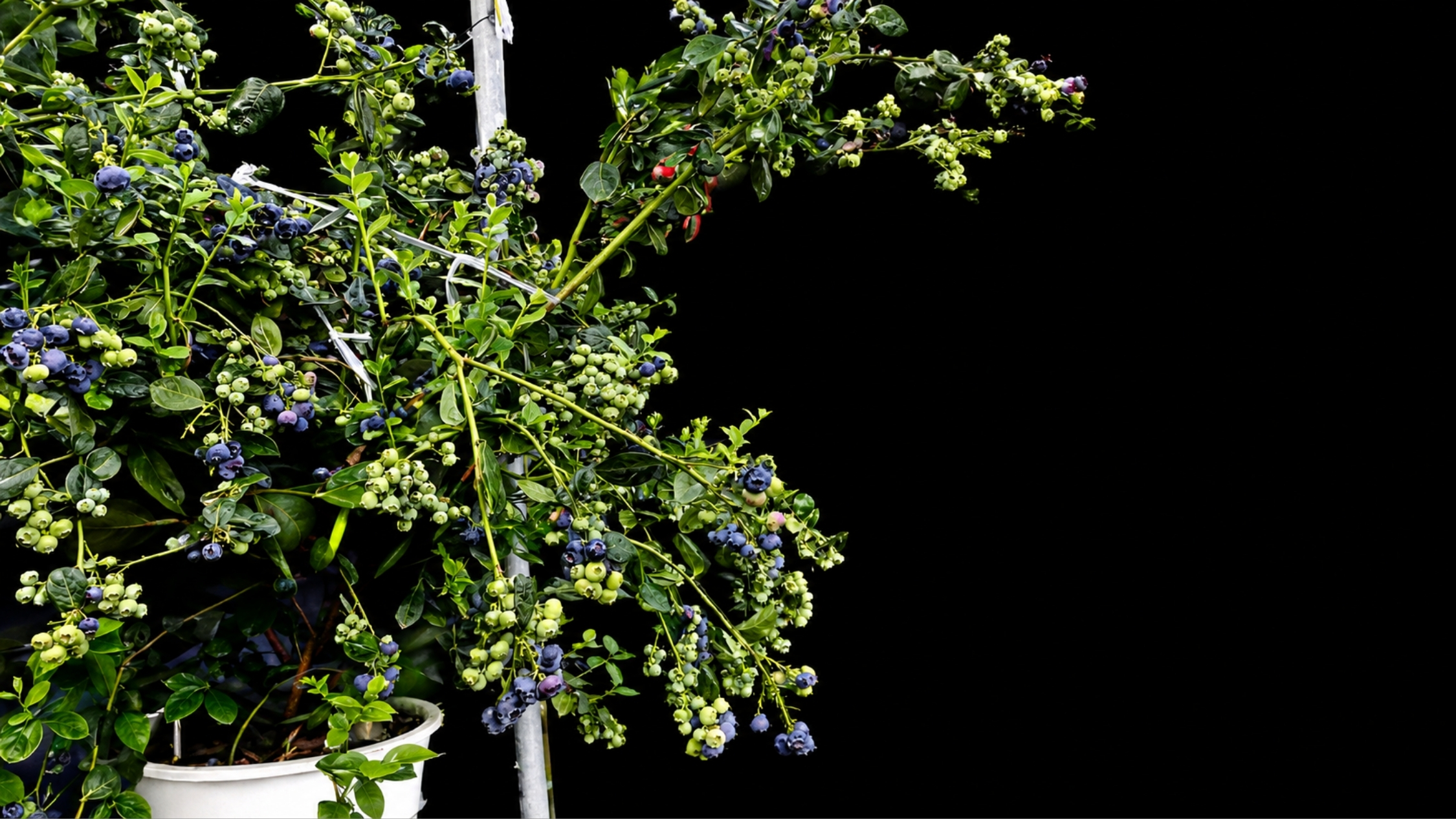
Croft exists to improve food security by making farming more stable, more sustainable, more financially attractive, and less dependent on scarce expert labor.
Croft has already put plant-driven growing to work in lettuce, then in tomatoes. Now it is turning to blueberries, and the reason is labor. Labor is one of the highest costs in farming, and planning it well is a large part of whether a season turns a profit. A farm books its harvest crew before anyone picks the first berry, based on an estimate of how many berries are on the plants.
Counting the fruit directly is not practical, so the plan rests on an estimate. That estimate has limitations, and when it is wrong the cost to the grower can be steep. Croft is developing a 3D scanning tool that counts blueberries on the plant and estimates harvest weight. It is early, and it is still in research and development. What follows covers where today's estimates miss and what that costs, then how Croft is working on a counting method that can scale across the market.
The harvest estimate decides how many pickers a farm books and for how many days. A high estimate pays for crews the farm does not need. A low one leaves ripe fruit rotting on the bush.
Labor is also under pressure. The U.S. Department of Labor has finalized the 2026–27 minimum wage rates for H-2A, the federal temporary agricultural worker program, so the figures are set. They average $12.31 an hour for entry-level work (Skill Level I) and $16.07 for more experienced roles (Skill Level II), according to an American Farm Bureau Federation (AFBF) analysis. Those figures are national averages of state rates. The Farm Bureau also says that labor can run close to half the cost of production on farms generally.
And the problem does not stop at cost. Estimates have long leaned on grower experience, and the people who hold that experience are getting older. The average U.S. producer is 58.1 years old, and producers under 35 are 9% of the total, according to the 2022 Census of Agriculture. In South Korea, provisional results from the 2025 census put 51.3% of the farm-household population at 65 or older, an age when most people in other lines of work have already retired.
Counting every berry on every plant would take longer than picking them. So the labor plan has to rest on an estimate.
Blueberry crop estimates have long been informal guesses made from experience, according to a 2000 study by researchers at Michigan State University and Purdue University. That team tested five ways to sample a bush. The fast one, the hoop method, counts the berries inside a square frame about 25 centimeters (10 inches) on a side, close to the area of a sheet of printer paper, at several spots on a bush. It then scales that count up to the whole fruit-bearing surface of the bush, and the bush up to the field. Four of the five methods showed a statistically significant link to the yield of a single bush. The fifth, counting the berries on a single lateral (one side branch), did not.
The team then took hoop counts into growers' highbush fields in Michigan and Indiana. The estimates tracked actual yields, but they ran 15% to 40% above what growers harvested until the team corrected for harvest losses. Counted fruit is not harvested fruit. The count captures the plant on one day, and by harvest some of that fruit is gone.
The authors also named where the error enters. One hoop at mid-bush height may not represent the rest of the bush. Bush volume is hard to measure. Counting gets harder when canes bend under the weight of fruit. They asked whether ten bushes per one to two hectares is enough, though they judged harvest loss the likelier cause of the steady overestimate.
The harvest-loss gap from that study belongs to any count taken on the plant, a scan included. What a better count removes is sampling error, so the example below covers only that part. Take a hypothetical 20% sampling miss. The numbers come from stated assumptions, and none come from a real farm's books.
Take a farm that plans its crew for a crop 20% bigger than the one it gets. If picking labor is a third of what the crop is worth, booking for 20% more fruit than exists adds about 7 cents to every crop dollar in labor, paid to crews with nothing to pick. The same estimate feeds the forecast. Suppose the farm keeps 15 cents of every crop dollar after costs. For every $100 of fruit it actually harvests, it planned on about $28 of profit and ends up with about $8.
Cash flow takes the hit first. The farm schedules payroll and loan payments against the forecast, and the harvest arrives on its own timetable. A farm that planned on $28 and ayebreceives $8 has a gap to cover, and a thin-margin farm has little room to cover it. A bad estimate puts the business at risk.
A sample estimates a plant from a part of it. When the part is not typical, the whole is off, and the farm pays in labor and again in the forecast. A different approach starts with counting the plant itself.
Researchers have turned to cameras, and the hard parts show up quickly. Blueberries are small and densely packed, and leaves and twigs often hide them. The preprint's images cover localized branches rather than whole bushes. Its authors say future work has to image whole bushes from several viewpoints, and they describe an over-the-row platform in development for full-canopy detection. An image of one branch is still a sample, and it raises the question the hoop raised. Does this part stand for the whole bush? A Michigan State group has also developed a phone app for counting blueberries in canopy images.
Field tests at North Carolina State University found that absolute berry counts were more sensitive to lighting, canopy density and fruit hidden behind leaves or other fruit, camera distance, and the species or cultivar being imaged, according to NC State Extension. In the same tests, counts from the north and south sides of one bush were least consistent for unripe berries. In practical terms, two counts of the unripe berries on one bush, taken from different sides, can disagree.
These limits are hard to engineer around, and the reasons are mostly geometry. None of this criticizes the people building these tools. It describes what a single outside view can and cannot see.
Start with what the camera sees. A camera outside the canopy, whether a person holds it or a drone carries it along the row, records the outer layer. Whatever sits behind the first layer of leaves and twigs never reaches the lens. Croft's own phone demo faces the same geometry. Distance matters too, and the NC State tests found counts sensitive to it.
Then there is the double count. Video is a stream of frames, and the camera moves. One berry shows up in many frames from slightly different positions, and a flat image has no depth to say those sightings are one berry. A method can add rules to catch repeats, but each rule is a guess about which sightings belong together.
Hidden fruit works the same way. A method can estimate how many berries sit inside the bush from what it sees on the outside, which stacks a second estimate on the first.
Each of these fixes moves the goalpost back. Correcting for repeat sightings and extrapolating the hidden berries gives a better estimate, and it is still an estimate. It does not give a count the grower can treat as the number of berries on the plant. Whatever error remains flows straight into the labor plan and the forecast, the two places the last section priced.
Light and motion add to it. Light changes through the day and between rows, and NC State found counts sensitive to lighting. A camera held unsteadily, or moved in jerks, blurs the berries it is trying to count.
Hidden fruit and changing light are the problems a counting method has to handle with high fidelity before a grower can rely on its count. Croft decided to get involved because of those two problems.
Croft's tool starts with video of the plant taken from several angles. The video can come from any camera with high enough resolution, and Croft captured its demo video with a phone app.
Each frame is a photograph from a slightly different position. Multi-View Stereo (MVS) reconstruction works out where the camera was for each frame and finds the same points on the plant in overlapping frames. The shift between views gives how far away each point sits, and stitching those distances together rebuilds the video into one 3D map of the plant.
In that map, each berry has one position. A berry that appears in many frames lands in the same spot every time, so the tool counts it once. Because the camera moves around and through the plant, a berry hidden from one angle can show up from another, so fewer berries stay out of sight.
The map also carries size. Each berry is a measured object in 3D, so the tool can read its size, and size is what turns a count into weight. Size also shows how far along the fruit is in its growth, which makes the crop's growth stage easier to read. The count sets the labor plan. Weight sets the revenue forecast, because growers sell blueberries by the pound. The aim is a single pass through the rows that gives a grower both a better labor plan and a better profit forecast. Croft built the tool on its earlier cherry tomato model.
A scan takes about 5 minutes per plant. Counting the same plant by hand takes at least an hour. Croft is still testing overall accuracy, and lighting is one of the biggest factors in that work.
Getting camera angles that see the inside of the plant is the harder part. Berries inside the plant are still hidden, and Croft is working on this in controlled environment agriculture (CEA). Its research and development team is taking it in two steps. First, it makes the phone demo more reliable, then it extends the method to a customized GrowBot™ that can read the inside of the bushes better.
The tool is at demo stage and still in research and development. Accuracy varies widely with lighting and with how steadily and smoothly the camera moves during capture. A scan count stays an estimate until someone checks it against a hand count, and that means counting berries by hand, the slow work the tool is meant to replace.
Croft is continuing work on how to see inside the plant in CEA and testing the tool further in real conditions. The season is over, so Croft has put local testing on hold and cannot collect new data for now. Croft is talking with potential clients who would need the tool, and it is open to talking with commercial partners about scaling the method in the field.
Napkin math shows the scale. Cultivated blueberries in the United States were worth about $1.3 billion at the farm gate in 2025, from roughly 105,000 harvested acres, according to the U.S. Department of Agriculture (USDA). Say labor takes a third of that value, about $430 million a year spent on people to pick fruit that someone had to estimate first. If a better count made that planning just 10% more accurate, and the cost of a miss shrinks in proportion, the saving is about $43 million a year. Weight carries a second prize. A 10% better read on a $1.3 billion crop is $130 million of revenue a farm can plan its cash against.
The figures size the stake, and Croft's work is early. The math holds only if the count proves out.
The same arithmetic applies wherever crews are booked from an estimate, in greenhouses and open fields alike. Croft is working toward a count taken from the whole plant, so the harvest plan can rest on all of it instead of a part.


